
quattro All-Wheel Drive Technology: Engineering Architecture and Evolution
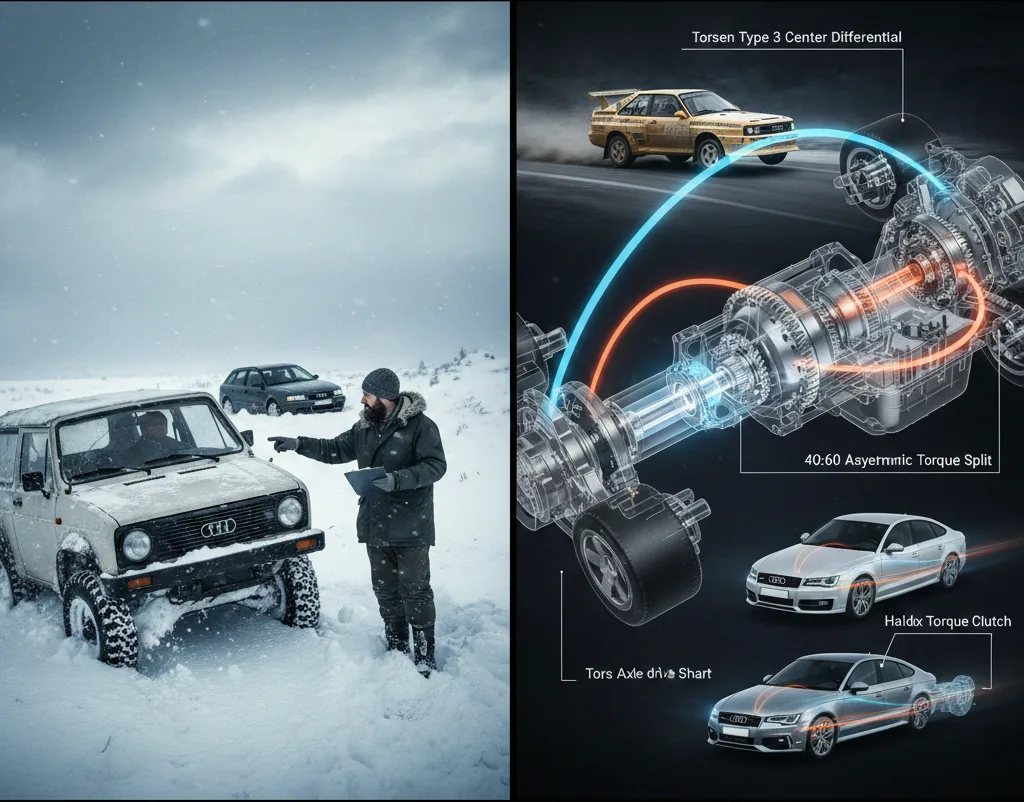
The quattro permanent all-wheel drive system was developed as a solution to provide a traction advantage for passenger cars in challenging road conditions. The concept originated in 1977 during testing of the VW Iltis off-road vehicle in Finland. Engineer Jörg Bensinger observed that the 75 hp off-roader outperformed more powerful front-wheel-drive Audi prototypes in terms of cross-country mobility and handling. Despite management skepticism regarding system weight, Ferdinand Piëch insisted on implementing all-wheel drive within the passenger car segment.
Engineering Concept and System Architecture
The primary design objective was to maintain transmission compactness for installation in a passenger car chassis without utilizing a bulky transfer case. Audi engineers developed and patented the hollow secondary shaft concept.
The design features a 263 mm shaft containing the front-axle drive shaft. This coaxial arrangement allowed the center differential to be integrated directly into the gearbox housing, minimizing parasitic mass and preserving the standard dimensions of the powertrain. Initial prototypes utilized suspension and transmission components from production Audi 80 and VW Iltis models to accelerate development.
Mechanical Operation and Technical Specifications
In the first-generation system (1980), the center and rear differentials were "open." Torque distribution was managed manually via mechanical locks with cable-actuated, and later vacuum-actuated, engagement.
From 1987, the system began utilizing the Torsen Type 1 self-locking differential (derived from "Torque Sensing"). Its operating principle is based on the physical inability of a helical gear to drive a worm gear. This allows for instantaneous power redistribution based solely on mechanics, without the need for electronic sensors.
Key characteristics of the classic Torsen-based layout:
- Static Torque Split: 50:50 between axles.
- Dynamic Redistribution: Up to 75% of torque to the axle with the better friction coefficient.
- Engagement: A permanently closed mechanical circuit, eliminating the engagement delays typical of on-demand clutch systems.
Generational Evolution
System development focused on altering center torque distribution and improving fuel efficiency:
- Asymmetric Distribution (2005): The RS4 (B7) introduced the Torsen Type 3 with a 40:60 rear-biased base ratio to neutralize understeer.
- Crown Gear Differential (2010): The introduction of the Crown Gear unit reduced weight and expanded the locking range. An internal plate clutch is used to manage preload levels.
- quattro ultra (2016): A transition to a dual-clutch layout that allows for a complete disconnect of the rear axle to reduce fuel consumption.
- Active Torque Vectoring (2008): The "Sport Differential" featuring step-up gears and multi-plate clutches on the rear axle for active wheel-to-wheel torque distribution.
Role in Motorsport
For Group B rally competition, the Sport Quattro was developed with a wheelbase shortened by 320 mm to reduce the moment of inertia. On the Sport Quattro S1 E2, a shift-under-load transmission—the precursor to modern DSG gearboxes—was developed in collaboration with Porsche.
In circuit racing, the system demonstrated such an advantage in the Trans-Am series (1988) that the Audi 200 quattro was deemed too effective, leading the SCCA to ban all-wheel drive from the championship.
A specific detail of the rally variants was a system to forcibly decouple the rear axle when the handbrake was engaged. This was necessary to ensure that locking the rear wheels in corners would not stall the engine through the shared drivetrain.
Layout Variations
Under the single "quattro" brand, different technical solutions coexist depending on the vehicle’s powertrain layout:
- Longitudinal Engine Layout: The classic configuration with permanent mechanical drive (Torsen or Crown Gear).
- Transverse Engine Layout (A3, TT): Utilizes a Haldex clutch. Structurally, this is not a symmetric all-wheel drive system, as the second axle is engaged "on-demand."
Market Impact and Historical Context
Prior to quattro, all-wheel-drive passenger cars (e.g., the Jensen FF) were produced in limited series and considered commercially unviable. Audi brought the technology to the mass market, supported by capability demonstrations such as the Audi 100 CS driving up the Kaipola ski jump in 1986—performed without winches, though utilizing studded tires.
An interesting historical note: the system was nearly named "Carat." However, the legal department rejected the name due to existing trademark rights held by a perfume brand of the same name.